





 Back to Insights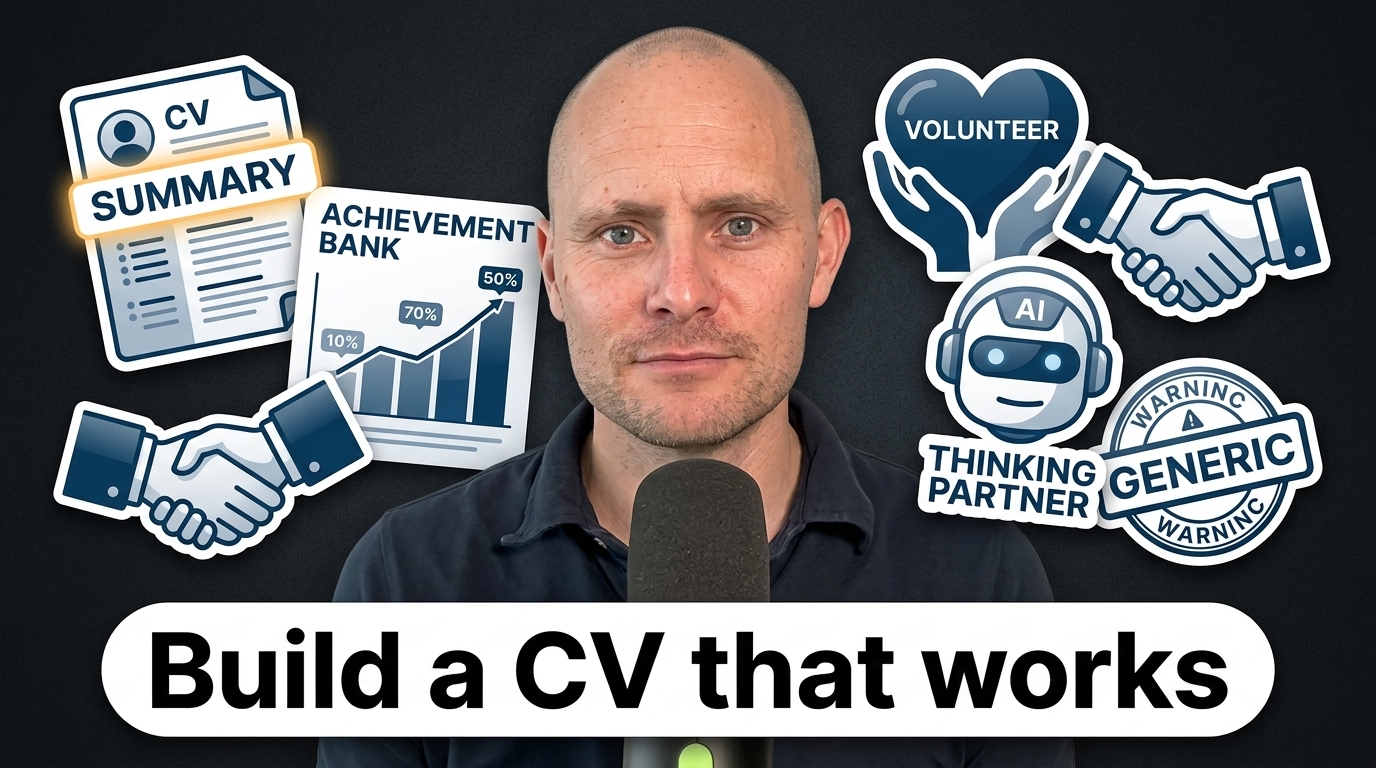
Free Job Tracker, Refreshed Course Videos, and a Drop-In Workshop: Here’s What’s New at the Charity Careers Network
The charity job market is brutal right now. Here's the free tool that puts you back in control.
If you’re searching for a charity sector role right now, you will already know that the market is tough. Fewer roles. More competition. And a job search process that can feel overwhelming, lonely, and random.
That’s exactly why we built the Charity Careers Network. And this month, we’ve made some significant updates that I want to tell you about: a completely free, Charisma-branded job tracker, six freshly updated course videos, and a drop-in workshop session on Friday 11 September where you can bring whatever you’re working on and get proper, practical help.
Watch the video below to see the tracker in action, then read on for everything that’s new.
What is the Charity Careers Job Tracker and why do you need one?
The tracker is a free spreadsheet, built specifically for charity jobseekers, that logs every application you make and shows you in real time where your job search is working and where it isn’t. It takes about two minutes per application to fill in and the dashboard updates automatically.
Most people manage their job search in their head, or across a rough collection of emails, browser tabs, and calendar reminders. That works fine for the first few applications. By the time you’re eight or ten roles in, it starts to fall apart. You lose track of where you are with each role. You miss a follow-up. You apply for something you looked at three months ago. And without a record, you genuinely can’t see patterns in what’s happening.
That last point is the most important one. The candidates who make the fastest progress in their job search are not always the ones who apply most. They’re the ones who know where their bottleneck is and fix it.
You can’t fix a bottleneck you can’t see. The tracker turns your job search from something that feels random into something you’re actually in control of.
The tracker has two tabs. The first is your main application log, with columns for the organisation, your contact, job title, location, salary, closing date, and a Days Left column that calculates automatically. There’s a Status dropdown with every stage covered: Applied, Wait for reply, Screening call, Interviewing, Final stage, Offer received, Ghosted, and more. And a Notes column where you can record anything useful from each interaction.
The second tab is the dashboard. This is where it gets interesting.
What does the dashboard actually show you?
It pulls data from your tracker automatically and calculates three things: your total application activity, your conversion rates at each stage, and a bottleneck diagnostic that tells you exactly where to focus your energy.
The conversion rates are the most valuable part. Applications to interviews: in the current charity market, getting through to interview on around 20 percent of your applications is a solid benchmark. If you’re significantly below that, the issue is almost certainly your CV or cover letter. Interviews to offers: aim for around one in three. Below that, and the focus should shift to interview preparation and how you’re telling your story in the room.
The bottleneck diagnostic reads your data and flags in plain language which stage needs attention. It’s not a judgement. It’s just data. And data is far more useful than anxiety.
To give you a sense of what the tracker looks like in practice, the mock data in the video includes applications to Shelter, RSPCA, Cancer Research UK, British Red Cross at Final stage, and Oxfam. And yes, there are also two slightly more aspirational entries in there. Sheffield United are advertising for a First Team Manager. And 10 Downing Street has a vacancy. Both are faithfully logged. The tracker does not discriminate.
Why have the course videos been updated?
Because the charity job market has changed significantly, and advice that was accurate a year ago is not always accurate now. The updated videos reflect the current reality so that the guidance you’re getting is grounded in what is actually happening.
Here is some of what has shifted. According to CharityJob’s most recent data covering over 55,000 roles, the number of charity jobs advertised fell by 18 percent in 2025. At the same time, the number of applications went up by 37 percent. The result is a market where strong, experienced candidates are routinely not getting shortlisted, not because they are not good enough, but because the competition has intensified significantly and the old approach to applications is no longer sufficient.
We have also seen major redundancy programmes across the sector. NCVO estimated that the National Insurance changes introduced in April 2025 cost the charity sector £1.4 billion annually. Household-name organisations have cut significant numbers of roles. And the people coming out of those redundancies are experienced, motivated, and applying for the same roles you are.
All six videos have been updated to reflect this. Fresh statistics, current market context, and practical guidance that works in 2026, not 2024.
What is new in the videos specifically?
The biggest change across all six videos is the thread on AI. 64 percent of charity candidates are now using AI tools to help with their applications, according to CharityJob’s own research. That is a significant majority. And more than half of charity recruiters said they were concerned about it.
The concern is not that candidates are using AI. The concern is how they are using it. When the majority of applicants use the same tools in the same way, the applications start to look identical. Polished, professional, and completely interchangeable. A recruiter who has read forty cover letters that morning can spot the pattern immediately.
The candidates cutting through right now are not the ones who avoid AI. They are the ones who use it as a thinking partner rather than a ghostwriter. Your specific story, your genuine connection to a cause, your actual achievements: those cannot be generated. And in a market flooded with AI-assisted applications, they are your competitive advantage.
Each video now addresses AI directly for that particular stage of the job search. How to use it well when writing your CV. What to avoid in a cover letter. How it is changing the way recruiters search LinkedIn and rank profiles. How panels are now probing specifically to test whether your interview answers are genuinely yours. And how AI tools can actually be helpful for negotiation preparation at the offer stage, if used correctly.
The fundamentals of good charity job searching have not changed. Mission alignment still matters more than almost anything else. Specific, evidenced, tailored applications still win over generic ones. And the ability to tell your story clearly and confidently still determines most outcomes. The updated videos hold all of that, and layer on what is new.
Come to the drop-in workshop on Friday 11 September
One of the things I hear most from people in the Charity Careers Network is that the job search feels isolating. Like everyone else has got it figured out and they are the only one struggling. They have not. The market is genuinely difficult right now and that is not a personal failing.
The drop-in workshop on Friday 11 September is an open session where you can bring whatever you are working on and get practical help. Your CV. A cover letter you are not sure about. An interview coming up that you want to prepare for. A role you have spotted and are not sure if it is worth applying for. Or just a general sense of being stuck and not knowing where to start.
There is no agenda and no slides. Just proper, practical support from someone who has spent years placing people into charity roles and knows what works in this market right now.
The session is free for Charity Careers Network members. If you are not yet a member, joining takes less than a minute and everything in the community is free.
How to get the tracker and join the community
The tracker is available free in the resources section of the Charity Careers Network. The six updated course videos are in the course area. And the drop-in workshop details, including the Zoom link, are pinned in the community.
If you are searching for a charity sector role right now, or you know someone who is, share this post. The market is tough and nobody should be navigating it without good information and proper support.
Join the Charity Careers Network at careers-network.mn.co.
Author

Share this post


Related posts